

California has approved a comprehensive plan to protect the western Joshua Tree, which is increasingly threatened by climate change and development pressures. The Western Joshua Tree Conservation Plan, announced on August 16, 2025, marks the first time the state has adopted a species-specific strategy under its new biodiversity law. This plan, developed by the California Department of Fish and Wildlife (CDFW), builds upon the foundation laid by the Western Joshua Tree Conservation Act (WJTCA) and has implications for how projects are permitted and impacts are mitigated.
A History of Western Joshua Tree Protection
The WJTCA was first introduced in early 2023. As detailed in the Western Joshua Tree Listing Status, the Act recognized the tree’s ecological and cultural significance, particularly to California Native American tribes. It mandated co-management principles, relocation options to tribal lands, and the integration of traditional ecological knowledge into conservation planning.
The Act also balanced environmental priorities with the state’s infrastructure and housing needs, allowing for incidental take permits (ITPs) under strict conditions. These permits, as outlined in the Western Joshua Tree Permitting Process, require applicants to either mitigate impacts directly or contribute in-lieu fees to the Western Joshua Tree Conservation Fund, which supports land acquisition and habitat management.
The 2025 Conservation Plan represents a significant evolution in California’s approach to species protection. Key initiatives include:
- Expanded habitat protections across the Mojave and Western deserts.
- Stricter permitting rules for development near Joshua trees.
- Enhanced funding mechanisms for conservation, including increased in-lieu fees and broader eligibility for mitigation banking.
- Community engagement mandates, requiring developers to consult with local tribes and conservation groups before initiating projects.
Requirements Under the 2025 Conservation Plan
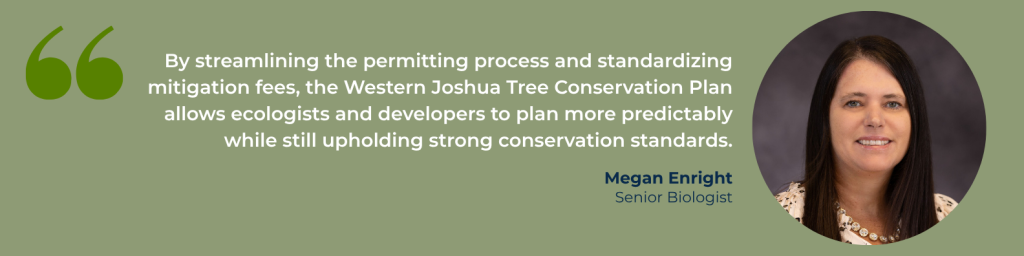
Building on this foundation, the newly approved Western Joshua Tree Conservation Plan introduces a more streamlined and locally responsive framework for protecting the species. It empowers cities and counties to issue certain permits, easing regulatory burdens for developers while maintaining strong environmental safeguards. “The 2025 Conservation Plan marks a major shift in how we approach species protection in California. By streamlining the permitting process and standardizing mitigation fees, the Western Joshua Tree Conservation Plan allows ecologists and developers to plan more predictably while still upholding strong conservation standards,” said Senior Biologist Megan Enright.
A standardized mitigation fee replaces complex case-by-case requirements, making compliance more predictable. Depending on the project’s scope and needs, developers also have the flexibility to choose between a WJTCA permit and a traditional CESA Incidental Take Permit.
Understanding the WJTCP ITP Application Process
To help stakeholders navigate this evolving landscape, it’s important to understand the steps involved in applying for a WJTCA ITP. Enright met with CDFW to discuss the WJTCA ITP application process and the timelines to expect.

- You must complete a western Joshua Tree census before you can apply for a WJTCA ITP.
- CDFW is notified once a WJTCA ITP application is submitted. Then a tracking number is issued, and a CDFW supervisor and staff member are assigned to your project.
- During the application review period, CDFW staff will reach out with questions via email, phone, or through CDFW’s Environmental Permit Information Management System (EPIMS).
- Once the review is complete, CDFW will prepare and submit an invoice with clear payment instructions. Fees range from $150 – $2,500 per tree and must be submitted before the permit can be issued.
It takes CFDW around 30 days to review applications and 90 days to issue a permit. To expedite the permitting process, CDFW recommends the following strategies:
- Communicate with CDFW early and often.
- Provide construction schedules to stay in communication about priorities.
- Email your assigned CDFW contact weekly.
To speed up permitting, CDFW urges teams to engage early, share construction schedules, and maintain weekly contact with their assigned representative.
Let’s Talk
Whether you’re navigating permitting, planning a project in Joshua Tree habitat, or seeking strategic guidance on conservation plan compliance, Dudek’s experts are here to help.
Dudek has successfully performed multiple western Joshua Tree censuses and prepared numerous WJTCA ITPs, ensuring strict compliance with CDFW requirements.
Contact us to explore how Dudek can support your project goals and help you ensure compliance throughout project development.
About the Expert
- Megan Enright is a senior project manager with more than 25 years of experience in environmental planning, specializing in biological resource analysis, regulatory compliance, and botanical surveying. She brings deep expertise in endangered species surveys and leads complex permitting and interagency coordination efforts.