

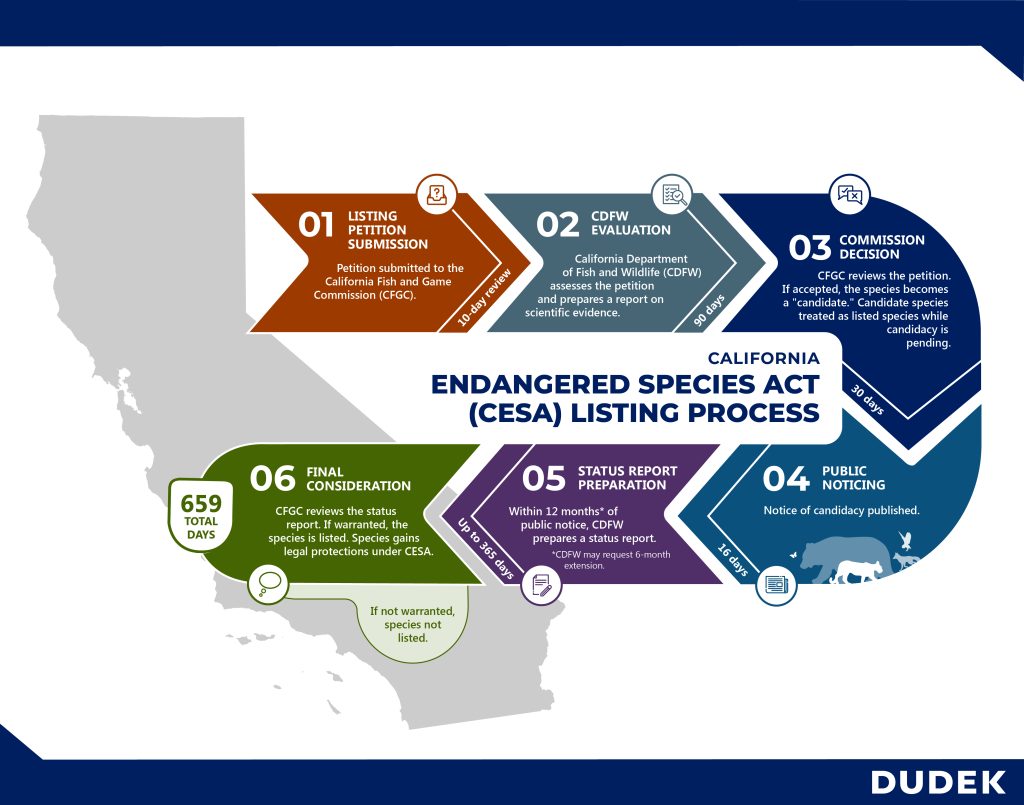
On October 10, 2024, the California Fish and Game Commission (CFGC) approved a petition to proceed with candidacy to list the western burrowing owl (Athene cunicularia, burrowing owl) as a threatened or endangered species in California under the California Endangered Species Act (CESA). Under CESA, candidate species receive the same protections as officially listed species until a final decision is made, typically within one to two years.
There are three key questions to consider when determining how to proceed with your project:
- Is my project located in an area where burrowing owls may occur?
- Is my project located in an area where an existing habitat conservation plan (HCP) or natural community conservation plan (NCCP) provides coverage for burrowing owl?
- How will this decision impact project operations at each stage of my project?
Where do burrowing owls occur?
Burrowing owls can occur throughout California where there are open habitats, generally low to no slopes, and burrow resources.

Source: Gogol-Prokurat, M. (2016, Mar. 8). Burrowing Owl Range – CWHR B269 [ds907]. Calif. Dept. of Fish and Wildlife. Biogeographic Information and Observation System (BIOS). Retrieved October 7, 2024 from https://apps.wildlife.ca.gov/bios6/.
While there are resident breeding, migratory, and wintering individuals, their presence across California can be unpredictable. Further, the owls can colonize or recolonize suitable habitats at any time, including re-nesting hundreds of miles away after successfully nesting elsewhere within the same breeding season. Their use of burrow complexes for nesting and roosting makes them susceptible to a variety of impacts, such as entombment or crushing in burrows, pesticides, predation at the burrow entrance, and other human-caused presence, noise, and light effects that can negatively impact breeding success.
Where is burrowing owl covered by an existing HCP/NCCP?
Habitat conservation plans and natural community conservation plans are strategic frameworks designed to balance land use and development with the conservation of endangered species and their habitats. Some plans require mitigation measures to protect burrowing owls. If your project site is within an area where an approved plan outlines mitigation measures for burrowing owls, your project may be subject to the requirements laid out in the applicable plan.
Use our interactive mapping tool to determine whether your project site is within the boundaries of an existing HCP or NCCP that provides burrowing owl coverage.
ACCESS THE TOOL
How will this CESA listing decision impact my project?
Because burrowing owls occur throughout most of California, projects within the owls’ range must include avoidance, minimization, and mitigation measures to reduce impacts to the species, and the project proponent must coordinate with the California Department of Fish and Wildlife (CDFW) regarding the need to obtain an incidental take permit (ITP) while the final listing decision is pending.
- If your project site is within an area where burrowing owls are known to occur and your project is covered by an approved HCP/NCCP, adhering to the HCP’s or NCCP’s requirements is a straightforward method of ensuring compliance.
- If your project is outside an HCP/NCCP area, there are several steps to follow to ensure compliance, including conducting surveys, coordinating with CDFW, and/or outlining a plan to mitigate impacts to burrowing owls.
Specific activities to mitigate impacts to burrowing owls will vary depending on whether your project is in the planning, design, construction, or post-construction/compliance phase.
Planning
When a species is made a candidate for listing, there are more stringent regulatory survey and habitat analysis requirements during the planning phase, which may include the following.
- Breeding Season Surveys. Protocol-level breeding season surveys are generally required where suitable habitat exists. However, with the candidate listing, these surveys will likely become universally mandatory. Additionally, the listing will likely necessitate further studies into other aspects of the species’ potential occurrence and life history, ensuring that all factors influencing their survival are thoroughly understood and mitigated.
- Winter Surveys. Protocol-level winter surveys will likely also be required, as certain areas of California are crucial habitat for wintering burrowing owls. Owls in these seasonal regions are particularly vulnerable to negative impacts and mortalities.
- Habitat Use Analyses. Habitat use analyses will also likely be required. These analyses require studying foraging habitats to accurately identify areas that are utilized by the species to determine compensatory (replacement) habitat mitigation. By understanding how and where the species uses its habitat, you can better plan and implement measures to compensate for any habitat loss, ensuring that the species’ needs are met even as the project proceeds.
Design
New species listings can influence the design phase, especially when it comes to the presence of suitable or occupied habitats. By focusing on smart avoidance and minimization strategies, you can ensure protection of critical habitats, reduce regulatory burdens, and achieve a more sustainable and cost-effective project outcome.
- Smart Avoidance and Minimization. If suitable or occupied habitat is identified within the project area, it is important to implement project-specific smart avoidance and minimization strategies. These strategies are designed to allow burrowing owls access to adjacent habitats, reducing the potential for habitat disruption. By incorporating these measures into the design phase, you may be able to avoid time-consuming and costly ITPs. This proactive approach helps streamline the project timeline and budget while ensuring compliance.
- Mitigation Requirements. Implementing smart avoidance and minimization techniques can also reduce mitigation requirements. By ensuring that burrowing owls can access their habitat, developers can minimize the extent of habitat compensation. This can result in significant cost savings and a more efficient project design process. Additionally, it demonstrates a commitment to environmental stewardship, which can enhance the project’s reputation and garner support from regulatory agencies and the public.
Construction
To adhere to the new, stringent requirements, you may need to undertake thorough pre-construction surveys and obtain necessary permits.
- Pre-Construction Surveys. Strict pre-construction surveys may be necessary to determine if burrowing owls are present. If owls are detected, you will likely need to coordinate with CDFW. Because CEQA does not provide take coverage under CESA or other regulations such as the Migratory Bird Treaty Act, other mitigation measures may be mandated. These measures may include burrow buffering from impacts or limitations on construction periods. While buffering and avoidance during the breeding period were previously standard practices, the listing of the species may necessitate year-round buffering around burrows.
- Incidental Take Permits. If the construction site is currently occupied by burrowing owls and their habitat, project proponents may need to obtain an ITP. Even if the project has CEQA approvals and mitigation measures in place for passive relocation methods, those measures may now be considered “take” and require coordination with CDFW to secure an ITP. Active relocation methods that involve the capture and handling of owls would certainly require an ITP due to the direct interaction with the species.
Post-Construction and Compliance
The listing can impact the post-construction and compliance phase of projects by requiring that all minimization and mitigation measures are effective and maintained over time.
- Monitoring and Maintenance. CDFW will likely require ongoing monitoring to assess the effectiveness of minimization and mitigation measures. This includes maintaining artificial burrow structures that are designed to provide alternative habitats. Similarly, on-site mitigation lands will also need to be maintained to mimic natural open conditions. Regular monitoring will help ensure that these artificial burrows and foraging habitats are functioning as intended and being used by the owls.
- Compensatory Mitigation Lands. Management of compensatory mitigation lands will be a critical component of the post-construction phase. These lands are set aside to compensate for habitat loss due to development. Ensuring that these areas are properly maintained and continue to provide suitable habitat for endangered species will be essential. This may involve habitat restoration activities, invasive species control, good site control, and other land management practices.
- Relocation Efforts. If relocation efforts were part of the mitigation strategy, ongoing monitoring will be necessary to track their success. This may include telemetry tracking of individuals and ensuring that relocated individuals are thriving in their new habitats and that the relocation sites remain suitable over time. Any issues identified during monitoring will need to be addressed promptly to ensure the continued success of the relocation efforts.
What are my next steps?
Understanding the potential impacts of the burrowing owl listing on each phase of your project is crucial.
Use our interactive mapping tool to determine whether your project site is within the boundaries of an existing HCP or NCCP that covers burrowing owl.
- If your project site is within the boundaries of an existing HCP/NCCP, research the plan’s mitigation requirements.
- If your project site is not within the boundaries of an existing HCP/NCCP, you will still be expected to address the species and possibly implement avoidance, minimization, and mitigation measures to reduce impacts to the species.
Dudek has extensive experience navigating project scenarios that involve various listed species, with recent successes for Crotch’s bumble bee (Bombus crotchii) and yellow-legged frog (Rana boylii). Additionally, we have a long history of working with burrowing owls throughout the state, including performing protocol and novel surveys, habitat analysis, and relocation, creating artificial burrows, and preparing mitigation/management plans.
Contact us for support navigating the next steps.