

What are PFAS?
Produced by industrial/commercial facilities and present in consumer goods, per- and polyfluoroalkyl substances (PFAS) are a group of synthetic chemicals used in products that resist oil and water, control temperature, and prevent material degradation. Examples include non-stick cookware, pizza boxes and other paper-based food containers, stain-resistant fabrics and carpets, fire-resistant clothing and upholstery fabrics, rain gear, personal care products, detergents, and firefighting foams.
Although there are hundreds of PFAS compounds, perfluorooctanoic acid (PFOA) and perfluorooctyl sulfonate (PFOS) are the most studied and most prevalent. Dubbed “forever chemicals,” PFAS compounds comprise chemical bonds that make them difficult to break down, allowing them to bioaccumulate in living organisms. Some PFAS are highly soluble, making them relatively mobile in surface water and groundwater, and their persistence in soils allows them to leach into drinking water aquifers.
Their behavior in the environment is concerning, as long-term exposure to PFAS poses potential health risks. As such, environmental regulatory agencies recently enacted thresholds for PFAS in drinking water.
Where are they?
PFAS producers include airports, military installations, and industrial/manufacturing sites. Prior to regulations, firefighting foam that contained PFAS was commonly used and stored at the same facilities that used and stored highly combustible materials, such as jet fuel, and at airports and military installations where firefighting and fire training activities are performed.
Industrial/manufacturing sites where PFAS are produced and used emit PFAS from air stacks that can impact nearby soil and surface water bodies. At these sites, PFAS can also be present in wastewater discharge.
Other sources include wastewater treatment plants (WWTPs) and landfills. WWTPs accept large quantities of wastewater from industrial facilities that produce PFAS and leachate that can contain PFAS from landfills. Treated water may contain residual PFAS that can impact local groundwater aquifers. Landfills are the final destination for non-recyclable materials from WWTPs and waste from household, commercial, and industrial sources. These waste materials may leach PFAS into the soil or groundwater. PFAS can also be present in landfill leachate, which, paradoxically, is often sent to WWTPs for treatment and disposal. To compound the problem, some landfill liners/membranes also contain PFAS.

It should be noted that landfills and WWTPs are not producers of PFAS per se, they are receivers and have limited authority to regulate PFAS sources entering their systems.
How are PFAS regulated?
The Comprehensive Environmental Response, Compensation, and Liability Act (CERCLA) lists PFOA and PFAS as hazardous substances, which allows the U.S. Environmental Protection Agency (EPA) greater flexibility in addressing PFAS contamination. California regulatory agencies, such as the California State Water Resources Control Board (State Water Board), Department of Toxic Substances Control (DTSC), California Air Resources Board (CARB), and the California Office of Environmental Health Hazard Assessment (OEHHA), have taken steps toward monitoring and regulating these compounds, most of which are documented on the State Water Boards’ PFAS website. The website also provides a central point where information is communicated to the public regarding PFAS investigative actions that have been conducted and the results of those actions.
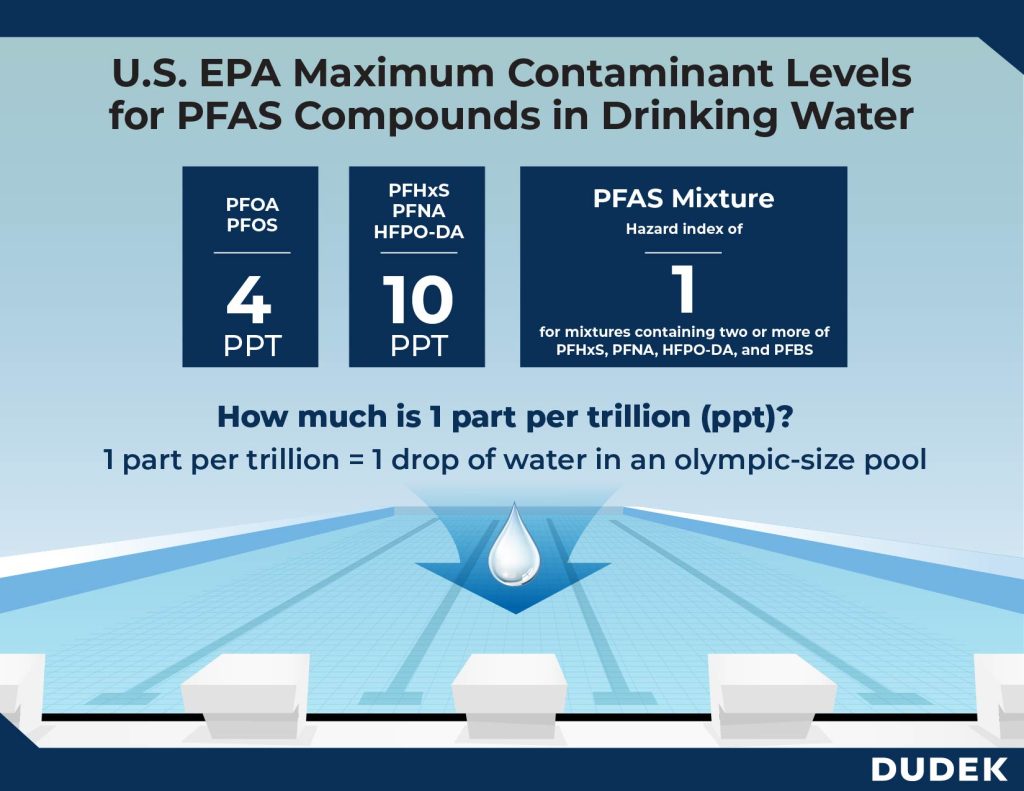
In April 2024, the EPA finalized the National Primary Drinking Water Regulation (NPDWR) that established the Maximum Contaminants Levels (MCLs) for PFAS:
- 4.0 parts per trillion (ppt) for both PFOA and PFOS
- 10 ppt for PFHxS, PFNA, and HFPO-DA
- A hazard index of 1 for mixtures containing two or more of PFHxS, PFNA, HFPO-DA, and PFBS
What is the regulatory impact?
PFAS regulations affect many activities, including those in the automotive, aerospace, construction, electronics, and water industries. Conventional water treatment processes that remove toxins and microorganisms from raw drinking water are relatively ineffective in eliminating PFAS from finished water, posing an issue for public water supplies and wastewater treatment facilities.
As regulations are implemented and new industry standards are adopted, municipal facilities and private property owners may be required to conduct additional investigations to evaluate for the potential presence of PFAS at their sites, even if they previously received regulatory closure.
How can Dudek help?
Individual PFAS compounds differ in their physical and chemical properties, as well as behavior, so even minor differences in environmental properties (e.g., soil moisture, clay content, and organic matter) can have a substantial effect on their mobility. Because of this, addressing them as a single contaminant group can result in overlooking the most efficient approach to intercepting or treating the most mobile and/or toxic compounds. Rather, care should be taken to isolate specific compounds that are present on a site-specific basis to reduce the number of target compounds or compound groups monitored at every sampling point. Additionally, knowing which of the compounds are likely to be the most mobile in a specific area (e.g., aquifers, surface waters, sediments, or soils) is essential to selecting the most cost-effective methods for addressing the problem. This considered approach saves time and money in the interception, removal, or treatment (in-situ) of the contaminants.
Dudek environmental engineers, geochemists, and hydrogeologists can determine which PFAS compounds pose the greatest threat in a particular environment by combining knowledge of individual compound properties with specific characteristics of the soil or water in which they are found.
For example, Dudek scientists have worked with regulators to implement sampling programs for public and private sites. As such, we understand sampling protocols; the most effective remediation technologies; laboratory technologies, methods, and pricing; and the risks associated with contamination.
Dudek scientists have also assessed the probable sources of PFAS in groundwater based on ambient water chemistry and aquifer characteristics, as well as the co-occurrence of these compounds with other contaminants and distinctive components of the natural waters. As a result, our investigation and/or remediation efforts targeted the sources and environmental pathways that most likely contributed to the contamination. In addition, the assessment identified which PFAS compounds would continue to be transported in groundwater farther from the source(s) if no action were taken. This provided the client and regulators a basis upon which to select among the various options for follow-up investigations.
Contact us for more information about how Dudek can help address PFAS that may your projects.