
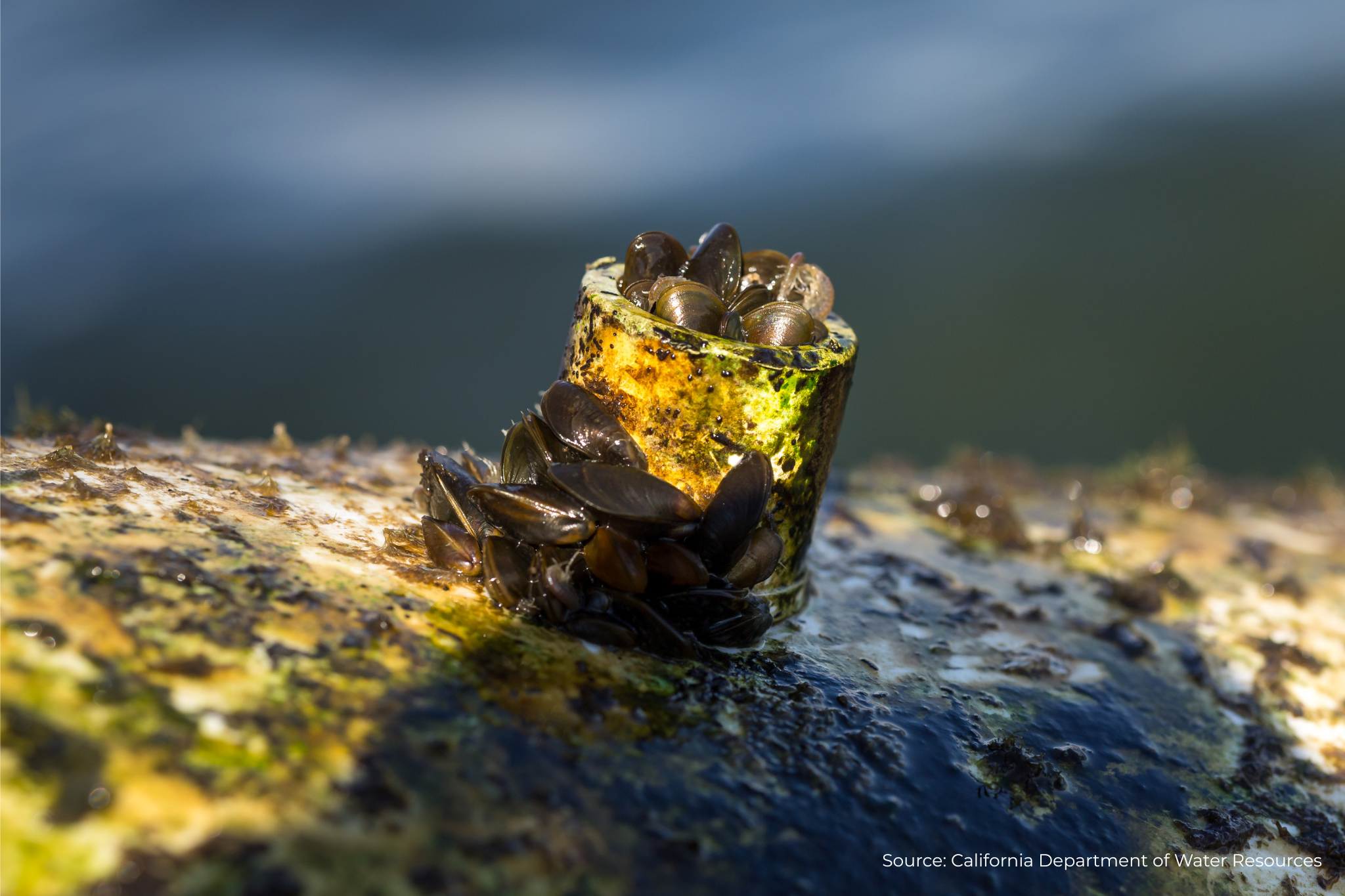
Golden mussels (Limnoperna fortunei) are no longer a distant or theoretical threat. Since their detection in 2024, these highly invasive mussels have moved through California’s interconnected water systems that support millions of residents and vast agricultural regions. For water agencies, the implications extend beyond invasive species management.
Golden mussels introduce a new layer of infrastructure risk that affects how water moves, how systems perform, and how reliably water can be delivered. Across the state, the focus is on action, with agencies moving quickly to assess vulnerabilities, plan for system impacts, and implement strategies that align with real operational conditions.
Agencies Are Acting Now to Control Golden Mussel Risk
Golden mussels spread through the same interconnected systems that move water across California, meaning risk will not stay localized.
“Wherever water is flowing, if there are veligers in the water, they’re going to go in that direction,” Valerie Goodwin, Dudek Biologist and bivalve expert, said. They can’t swim upstream, but they’ll get moved downstream, and they’ll move into other agencies’ footprints through those connections.”

As golden mussels establish, they can attach to infrastructure, affecting system performance and increasing maintenance demands. “Golden mussels have the potential to disrupt water delivery systems that millions of Californians rely on. Over time, they can reduce efficiency, restrict flow, and increase maintenance demands if left unmanaged,” Goodwin said.
Protecting waterways from golden mussels is well underway across California’s largest and most complex water systems.
Supporting Agencies Since the Start
Since the earliest stages of detection more than 18 months ago, Dudek has been working alongside leading water agencies to help guide response efforts and support implementation. That work began with the California Department of Water Resources as it mobilized to protect the State Water Project, one of the most complex water systems in the world, which delivers water to more than 26 million residents and supports hundreds of thousands of acres of farmland.
Dudek is also supporting agencies, including the Friant Water Authority and the East Bay Municipal Utility District, as well as numerous other districts across the state with vulnerability assessments, treatment protocols, and long-term system design and maintenance to accommodate the realities of golden mussels.
“A vulnerability assessment isn’t the finish line; it’s the starting line for decisions that protect your system.” – Bob Martin, PE, Principal Engineer
With direct insight into how agencies are navigating infrastructure constraints, regulatory requirements, and operational realities, our biologists, engineers, and permitting experts are establishing best practices and improving knowledge and methods in real time.

Research That’s Informing What Comes Next for Golden Mussel Mitigation
Native to Asia, golden mussels introduce new considerations for infrastructure systems in North America, where there is no management history for the species. In response, Dudek’s biologists have been conducting targeted research to understand how golden mussels behave in local systems and how management strategies perform under real-world conditions. This targeted research allows agencies to evaluate control methods, assess feasibility, and confidently navigate the regulatory pathways required to act.
“Dudek isn’t just adapting protocols used for zebra and quagga mussels. Our research and monitoring are actively developing best practices to manage and mitigate impacts of golden mussels as dealing with this invasive aquatic species becomes a new reality for California’s water managers”, said Senior Biology Project Manager Stephen Burkholder.
The Path Forward Is Well Underway
Water agencies are tasked with maintaining reliable water delivery under changing conditions.
“Golden mussels can disrupt the supply of water to agricultural, industrial, and residential users. That is the core concern, because water is fundamental to life.” —Servando Diaz, PE, Engineering Project Manager
For agency leaders, the priorities are clear:
- Act early to understand infrastructure vulnerabilities
- Coordinate across disciplines and systems
- Apply solutions that align with operational and regulatory realities
Dudek’s ongoing work with agencies across the state reflects these priorities in action, combining applied research and hands-on implementation to support decisions that protect critical water infrastructure. As conditions continue to evolve, this work is shaping how golden mussels will be managed nationwide, with approaches grounded in science, operational experience, and holistic planning.
About the Experts
- Valerie Goodwin is an aquatic biologist with 10 years of experience, specializing in oyster restoration and bivalve ecology. She brings deep expertise in invasive species research, monitoring, and treatment strategy, translating biological data into practical, system‑specific management decisions. Her work bridges research and operations, helping clients understand how life‑cycle dynamics, water quality, and infrastructure vulnerabilities shape effective, defensible golden mussel treatment and long‑term risk reduction. Her golden mussel expertise has been featured at industry events and in the news.
- Bob Martin, PE, is a principal engineer with more than 30 years of experience in water infrastructure operations and engineering. His expertise spans large-scale water conveyance systems, infrastructure reliability, and long-term asset management, helping agencies translate risk assessments into practical, implementable strategies that align with system constraints. He supports Dudek’s golden mussel response efforts, bringing an operations-driven perspective informed by his previous role as Facilities O&M Director for the San Luis & Delta-Mendota Water Authority.
- Stephen Burkholder is a biologist with more than 20 years of experience in aquatic system management, water quality, integrated pest management, and regulatory consulting. He specializes in developing practical, implementation-focused solutions for complex water resources challenges. His recent work includes supporting vulnerability assessments, treatment planning and monitoring, Aquatic Animal Invasive Species NPDES permitting, mitigation cost and feasibility analyses, and implementation planning in collaboration with the California Department of Water Resources, East Bay Municipal Utility District, Arvin-Edison Water Storage District, Westside Water Authority, Solano County Water Agency, Central California Irrigation District and other water agencies.
- Servando Diaz, PE, is an engineer and project manager with 17 years of experience in water, wastewater, recycled water, and agricultural irrigation system design, with an emphasis on infrastructure planning and system improvements. Servando brings a practical, operational‑aware perspective to invasive mussel response, helping agencies evaluate infrastructure risk, treatment feasibility, and long‑term operability to ensure solutions perform in real‑world conditions.